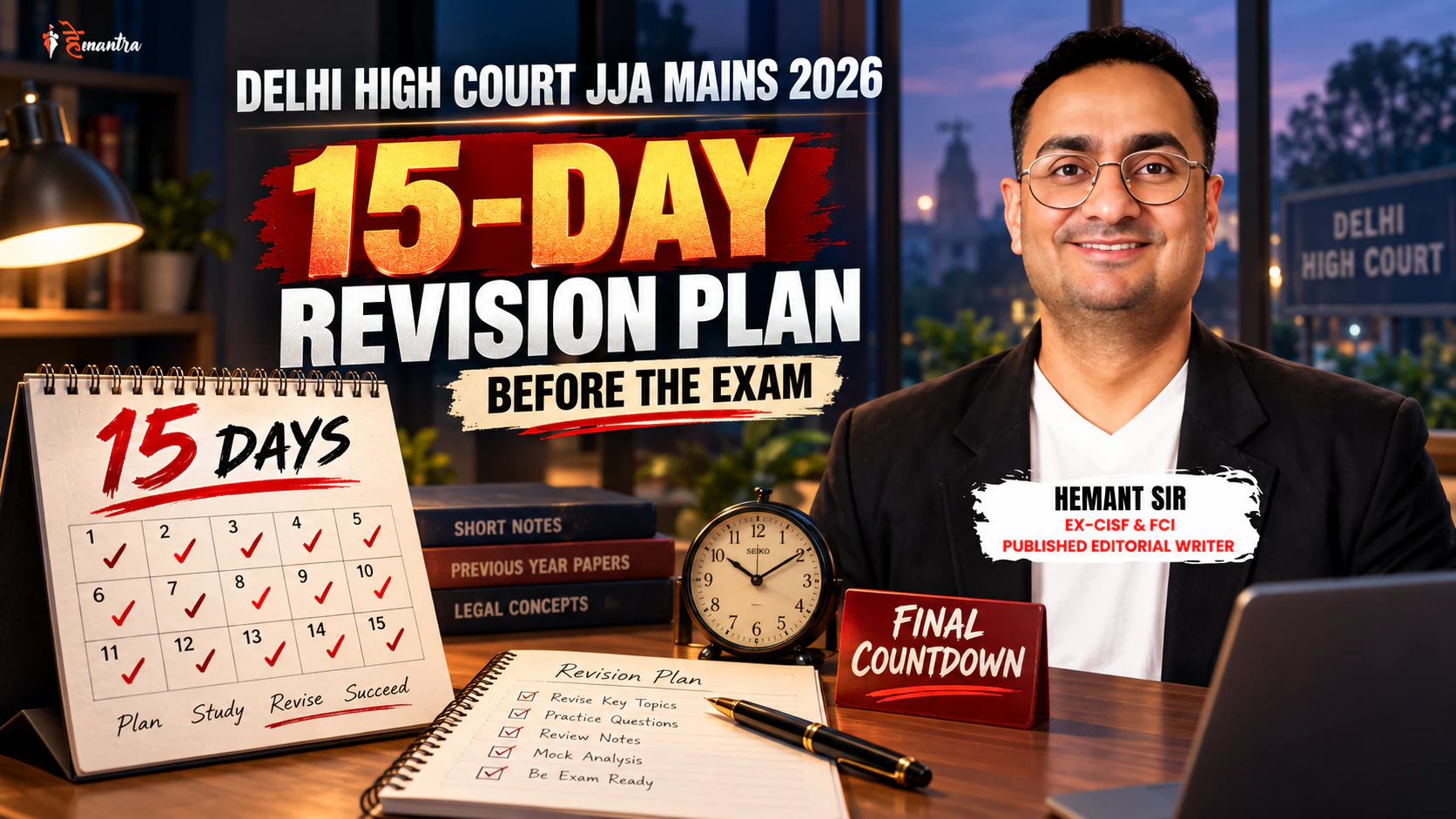
The Delhi High Court JJA/Restorer Stage-II Mains (Descriptive) Examination 2026 is scheduled for 4 October 2026 in Delhi-NCR. Delhi High Court has published the Stage-II schedule on its official recruitment portal, and candidates should continue checking the official Delhi High Court website for admit-card instructions and any further notices.
Official Delhi High Court Website
If you followed our earlier 25-day preparation roadmap, the final 15 days are where your preparation must shift from learning to execution. Before starting this revision plan, you can revisit HeMantra’s detailed guide:
The final phase should revolve around one cycle:
Revise → Write → Test → Evaluate → Correct → Retest
This is not the time to collect more material. It is the time to make sure that what you already know can be reproduced accurately within 120 minutes.
Delhi High Court JJA Mains 2026 Exam Pattern
The current Stage-II Mains is a 100-mark English descriptive examination of 120 minutes. The paper consists of Essay Writing for 40 marks, Letter Writing for 10 marks, Grammar for 30 marks and Translation for 20 marks. Stage-II marks also contribute to final merit along with the Interview; the Preliminary Examination and Typing Test are qualifying stages.
| Section | Marks |
|---|---|
| Essay – about 250 words | 40 |
| Letter Writing | 10 |
| Grammar | 30 |
| Translation | 20 |
| Total | 100 |
| Time | 120 Minutes |
You can also check the broader Delhi High Court JJA preparation ecosystem, PYQs and updates on HeMantra here:
Delhi High Court JJA Mains: 15-Day Revision Plan
If the examination is on 4 October, this plan can be followed from 19 September to 3 October.
| Day | Main Focus | What to Do |
|---|---|---|
| Day 1 | Diagnostic Mock | Attempt one complete 100-mark paper in 120 minutes and identify weak sections. |
| Day 2 | Essay Writing | Write two 250-word essays and evaluate structure, relevance and grammar. |
| Day 3 | Grammar | Revise and practise error correction, articles, prepositions, voice, tenses and transformation. |
| Day 4 | Translation | Practise Hindi-to-English and English-to-Hindi translation. |
| Day 5 | Letter + Grammar | Write two formal letters and attempt one timed grammar set. |
| Day 6 | Full Mock 1 | Attempt the complete descriptive paper under exam conditions. |
| Day 7 | Error Correction | Analyse Mock 1 and rewrite weak answers. |
| Day 8 | Essay Revision | Revise high-priority themes and write one timed essay. |
| Day 9 | PYQ Day | Revisit previous Delhi High Court descriptive papers. |
| Day 10 | Full Mock 2 | Attempt another 120-minute mock and compare performance. |
| Day 11 | Grammar + Translation | Focus on these 50 marks and recurring mistakes. |
| Day 12 | Essay + Letter | Attempt both sections consecutively under a time limit. |
| Day 13 | Full Mock 3 | Simulate the actual examination completely. |
| Day 14 | Final Error Revision | Revise your error notebook, formats and recurring mistakes. |
| Day 15 | Light Revision | Avoid heavy mocks; revise briefly and prepare for exam day. |
Days 1–5: Diagnose Before You Revise
Do not assume you know your weakest area.
Attempt a diagnostic paper first.
One candidate may have strong essay content but weak grammar. Another may know grammar but translate unnaturally. A third may know all four sections but fail to complete the paper within two hours.
That is why your first five days should be used to identify the actual reason you are losing marks.
Create a small error notebook. Record recurring issues such as subject-verb errors, wrong prepositions, weak essay introductions, poor letter format, literal translations and repeated spelling mistakes.
Your revision should become increasingly personalised.
For the larger preparation framework, return to the:
25-Day Delhi High Court JJA Mains Preparation Strategy
The 25-day article tells you what to build; this 15-day plan tells you how to consolidate it.
Days 2 and 8: Revise Essay Topics Strategically
Essay carries 40 marks, so it deserves daily attention—but not daily memorisation.
Do not try to learn 40 complete essays.
Instead, prepare broad themes that can be adapted to different questions. Your priority themes should include technology, judiciary, cybercrime, privacy, social media, urbanisation, employment, women’s participation, environment and public health.
For a ready-made theme bank based on PYQs and current relevance, use:
Delhi High Court JJA Mains 2026 – Most Expected Essay Topics
For each theme, prepare a usable introduction, four or five dimensions, one or two examples, key challenges and a forward-looking conclusion.
Then write.
Reading a model essay does not establish that you can reproduce a coherent 250-word answer under time pressure.
Your essay cycle should be:
Brainstorm → Write → Evaluate → Correct → Rewrite
Days 6–10: Shift From Preparation to Performance
From Day 6, complete mocks become important.
A practical starting time allocation may be around 35–40 minutes for Essay, 10–15 minutes for Letter, 30–35 minutes for Grammar and approximately 20 minutes for Translation, leaving any remaining time for review.
This is not an official Delhi High Court allocation. It is only a practice framework.
Your own mock performance should determine the final distribution.
The key rule is simple:
Do not allow the 40-mark essay to consume the time required for the remaining 60 marks.
After every mock, do not immediately move to the next test.
Analyse first.
If the essay was weak, rewrite it. If grammar accuracy fell, revise the relevant rules and solve another set. If translation was unnatural, redo the passage.
A mock should change what you do the next day.
Day 9: Return to Previous Year Question Papers
PYQs should return to your preparation in the final week.
The Delhi High Court officially maintains a Previous Years Question Papers section for recruitment examinations. In April 2026, the Court also issued a circular confirming that open-examination question papers are uploaded on its website under Recruitment → Previous Years Question Papers → Direct Recruitment – Non Judicial.
Official Delhi High Court Previous Year Question Papers
For HeMantra’s detailed analysis of the JJA papers and what the 2017 and 2020 papers reveal about essay, letter, grammar and translation, use:
Delhi High Court JJA Previous Year Question Papers: PYQs, Essay Topics & Descriptive Paper Analysis
In the final phase, do not merely read PYQs.
Attempt them.
Ask whether you can produce the answer within the actual word and time limits.
That is far more valuable than reading another predicted paper.
Days 11–13: Grammar and Translation Can Change Your Score
Candidates naturally focus on the 40-mark Essay.
But:
Grammar + Translation = 50 Marks
That is half the Stage-II paper.
For grammar, practise questions instead of spending the final week rereading theoretical rules.
Focus on areas visible in previous Delhi High Court papers and your own errors: articles, prepositions, subject-verb agreement, voice, verb forms, sentence correction and transformation.
For translation, avoid word-for-word conversion.
Suppose the Hindi sentence is:
सरकार को साइबर अपराध से निपटने के लिए प्रभावी कदम उठाने चाहिए।
A natural English rendering is:
The government should take effective measures to tackle cybercrime.
The target is:
Meaning + Grammar + Natural Expression
not literal substitution.
By Day 13, attempt your most serious full mock: two hours, no notes, no phone, no breaks and no extra time.
Days 14–15: Stop Adding New Material
The final two days should become lighter.
Do not suddenly download “100 expected essays”, “500 grammar rules” or a completely new translation book.
Revise your own error notebook.
Review essay frameworks, formal letter structure, common grammar mistakes and corrected translations.
On 3 October, avoid an exhausting full-length paper.
Instead, confirm your examination instructions through the Delhi High Court Job Openings/recruitment page, prepare the necessary documents and reach the final day mentally fresh.
How the HeMantra 10-Day Challenge Fits Into This Plan
The final ten days are ideal for exam-condition practice.
HeMantra’s Delhi High Court JJA 10 Days Challenge is built around ten consecutive full-length mocks, fixed timings and disciplined examination simulation.
Delhi High Court JJA 10 Days Challenge – HeMantra
Candidates who need broader lessons, PYQ-oriented practice and evaluation can also use:
Delhi High Court JJA Stage-II Descriptive Programme
The objective is not simply to increase the number of tests.
The correct cycle is:
Mock → Analysis → Correction → Next Mock
Final Takeaway
The final 15 days before Delhi High Court JJA Mains 2026 should not increase the quantity of your preparation.
They should improve the quality of your execution.
By the final day, you should be able to write a relevant 250-word essay, complete a formal letter efficiently, protect marks in grammar, translate naturally and finish the entire descriptive paper within 120 minutes.
Your complete HeMantra JJA pathway should now look like this:
25-Day Strategy → Previous Year Papers → Expected Essay Topics → 15-Day Revision Plan → 10-Day Challenge
Use the 25-Day Preparation Strategy for the overall roadmap, the JJA Previous Year Papers Analysis to understand actual question trends, and the Most Expected Essay Topics to organise your final essay revision.
For official information, always give priority to the Delhi High Court official website and its recruitment notices rather than third-party exam updates. The Court’s current Job Openings page lists the Stage-II JJA/Restorer Mains schedule among its 2026 notices.
Stop Collecting. Start Executing.