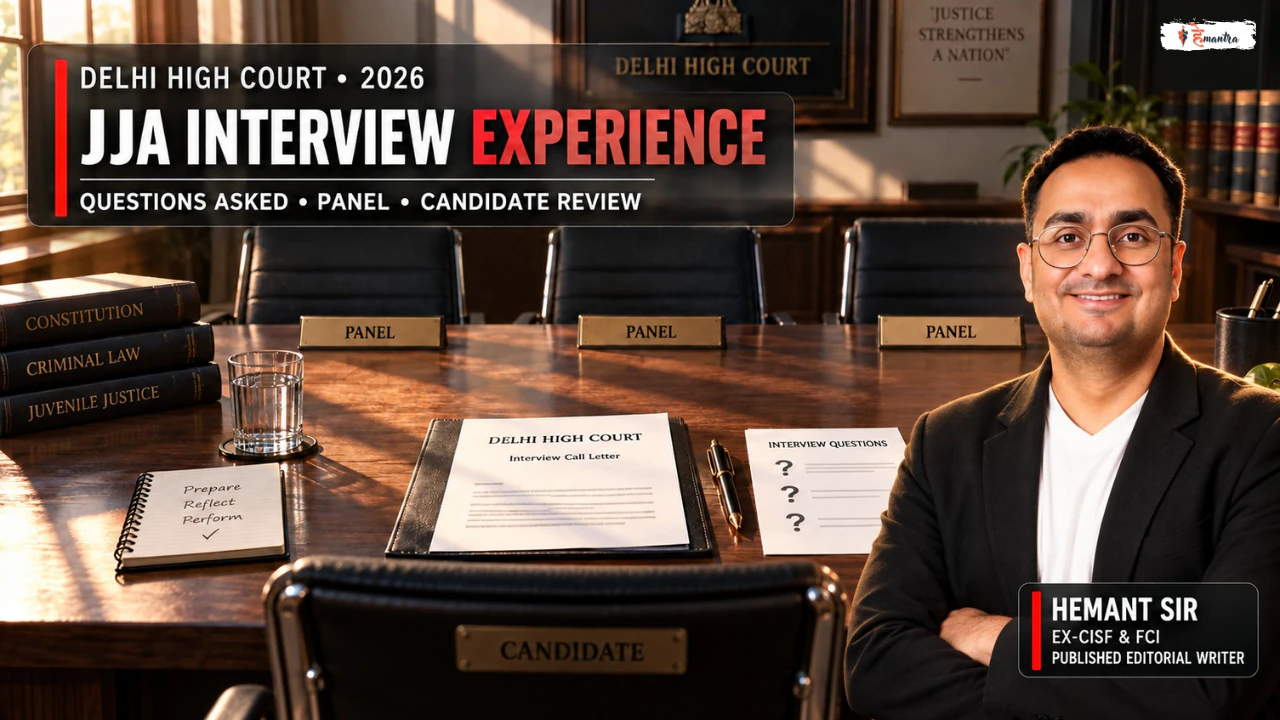
The Delhi High Court JJA/Restorer Interview 2026 will be the final stage of the recruitment process, but candidates should be careful when searching online for “2026 interview experience.”
As of 22 September 2026, the actual JJA Interview 2026 has not yet taken place. Delhi High Court has scheduled the Stage-II Mains (Descriptive) Examination for 4 October 2026, and no JJA Interview schedule is currently listed on the official Job Openings page.
Candidates should therefore treat any claim about exact 2026 questions asked, panel members or candidate experiences as unverified until the interview actually begins.
For official updates, keep checking the Delhi High Court Job Openings page.
This guide instead combines the current 2026 recruitment position with HeMantra’s Delhi High Court JJA guidance, selection discussions and practical interview preparation strategy.
What Can We Learn From Previous JJA Selection Experiences?
The JJA interview should not be prepared like another written examination.
HeMantra’s Delhi High Court JJA Course Orientation explains the complete preparation journey, including descriptive writing, typing-test guidance, interview planning and personality-development aspects.
Watch: Delhi High Court JJA Course Orientation | Complete Strategy & Guidance | HeMantra
HeMantra has also published a Delhi High Court JJA Selection – Real Success Story discussion covering the preparation journey, exam pressure, common mistakes, typing and interview readiness.
Watch: Delhi High Court JJA Selection | Real Success Story | HeMantra
The important lesson from such preparation discussions is that the final stage is not only about factual knowledge.
Candidates also need:
Clarity + Communication + Confidence + Institutional Awareness + Composure
A particularly relevant resource is HeMantra’s discussion with Utkarsh Srivastava, a selected candidate. The video discusses the real competition in JJA recruitment, typing pressure, mistakes aspirants make, exam temperament and the importance of confidence as candidates move towards the interview stage.
The right way to use such a candidate experience is not to copy answers. Use it to understand the larger journey:
Written preparation → Typing pressure → Selection competition → Interview readiness
HeMantra’s complete JJA programme also includes interview preparation and one-to-one live interview mocks, which can be useful once candidates reach the final stage.
What Can the Delhi High Court JJA Interview Panel Ask?
There is no official question bank for the 2026 interview, so memorising hundreds of “expected questions” is not the right strategy.
Instead, prepare six broad areas: your personal profile, Delhi High Court, the JJA role, judiciary basics, current affairs and situational judgement.
A panel may begin with something as simple as:
“Tell us about yourself.”
Your answer should cover your current status, educational or work background, relevant strengths and career motivation. Keep it concise.
From there, questions can move towards your graduation subject, hometown, work experience, hobbies or current occupation.
Anything you mention can become a follow-up question.
If you say Economics is your favourite subject, revise Economics. If you mention cricket as a hobby, be prepared for cricket. If you already work somewhere, prepare for:
“Why do you want to leave your present job?”
Your profile should therefore be genuine rather than impressive-looking.
“Why Do You Want to Join Delhi High Court?”
This is one question every serious candidate should prepare.
Avoid a generic answer such as:
“Delhi High Court is prestigious and I want a secure government job.”
A better answer connects the institution, the JJA role and your own skills.
For example:
“Sir/Ma’am, I want to join Delhi High Court because it provides an opportunity to work in a disciplined judicial-administrative environment where accuracy, responsibility and confidentiality are important. The JJA role also matches my strengths in computer work, documentation and communication. I would like to contribute efficiently while learning the Court’s procedures and developing professionally.”
Do not memorise this word for word. Adapt it to your own background.
Know the Delhi High Court Before the Interview
If you want to work in the Delhi High Court, the panel can reasonably expect basic institutional awareness.
Before the interview, revise the Court’s history, present Chief Justice, broad jurisdiction, writ jurisdiction, Articles 214, 226 and 227, basic court hierarchy and major digital initiatives.
Use the official Delhi High Court website for final revision because judges, notices and institutional details can change.
Official Delhi High Court Website
You do not need to speak like a law graduate.
For this type of interview:
Simple + Correct + Relevant
is better than complicated legal terminology that you cannot explain.
Understand the JJA Role
Many candidates prepare General Knowledge extensively but cannot clearly answer:
“What does a Junior Judicial Assistant do?”
Prepare around the broad nature of judicial-administrative support: computer-based office work, documents, records, correspondence, accuracy and responsible handling of official information.
Likely situational questions may include:
Why is confidentiality important?
What would you do if you noticed an error in an official record?
How would you handle two urgent assignments simultaneously?
What qualities should a JJA possess?
Your responses should consistently demonstrate:
Accuracy + Discipline + Confidentiality + Responsibility + Procedure
For example, if you discover an error, do not say you would quietly fix everything yourself. A safer professional approach is to bring it to the concerned authorised official and follow the prescribed correction procedure.
Current Affairs: Prepare for Conversation, Not MCQs
Interview current affairs require explanation rather than one-line recall.
Focus on themes connected with:
Judiciary and Constitution, Delhi governance, Artificial Intelligence, AI in courts, cybersecurity, data privacy, e-Courts, access to justice and major national developments.
For every topic, prepare three things:
What happened? → Why does it matter? → What are its implications?
If the panel asks which recent issue you have been following, choose something you genuinely understand.
Do not memorise an editorial and reproduce it like an essay.
What Will the Panel Be Like?
Candidates naturally ask:
How many panel members will there be?
How long will my interview last?
For the 2026 JJA interview, exact panel composition and duration have not yet been officially announced.
Do not build your preparation around rumours such as “there will definitely be three members” or “the interview will last ten minutes.”
Prepare instead for a formal setting where different members may ask questions from completely different areas.
What If You Don't Know an Answer?
Do not bluff.
A calm:
“I’m sorry, sir/ma’am, I’m unable to recall that at the moment.”
is safer than inventing a constitutional provision, judgment or current-affairs fact.
Confidence does not mean answering every question.
It means remaining composed when you cannot.
Practise Speaking, Not Just Reading
Reading 100 interview questions is not the same as facing a panel.
Take 8–10 questions every day and answer them aloud.
Record yourself occasionally and check whether your answers are too long, memorised, indirect or full of filler words.
Mock interviews are especially useful because they introduce something books cannot provide:
Unpredictability
A panel may interrupt, change the subject or challenge your answer. Your preparation should teach you to remain clear even when the conversation does not follow your script.
Final Takeaway
The most important fact about the Delhi High Court JJA Interview Experience 2026 is that the actual 2026 interview has not happened yet. The official recruitment page currently shows the Stage-II Mains scheduled for 4 October 2026, not a JJA interview schedule.
Until genuine 2026 interview experiences become available, prepare what will matter regardless of the panel:
Your Profile + Your Post + Delhi High Court + Judiciary Basics + Current Affairs + Communication
And use genuine candidate journeys such as the Utkarsh Srivastava HeMantra discussion to understand the practical pressure behind the selection process—not as a source of memorised interview answers.
When the actual 2026 interviews begin, this article can be updated with candidate-reported questions, panel experience, interview duration and detailed reviews, clearly separated from official information.
Do not prepare a script. Prepare yourself for a conversation.