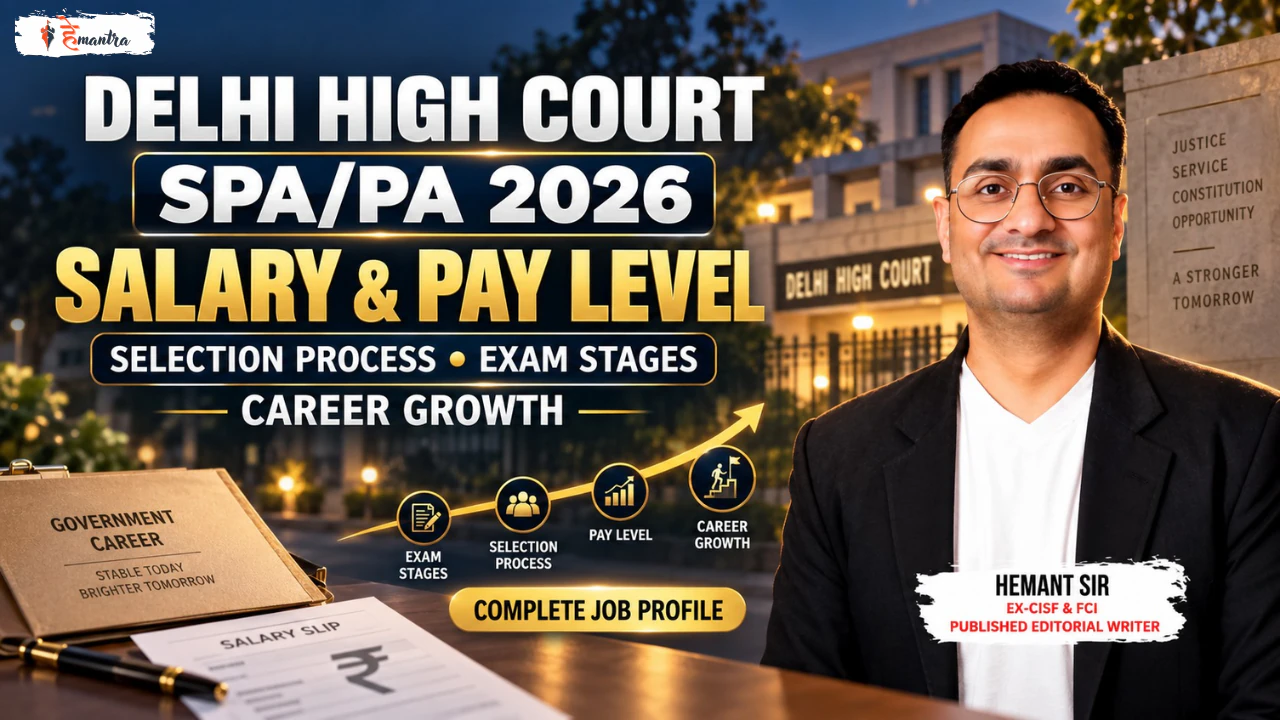
The Delhi High Court Senior Personal Assistant (SPA) and Personal Assistant (PA) Recruitment 2026 is one of the important Delhi High Court recruitment opportunities this year. The official notification announces 150 vacancies, including 117 Senior Personal Assistant posts and 33 Personal Assistant posts.
The vacancy notice was issued on 5 September 2026, while online applications are scheduled from 15 September to 5 October 2026. Candidates should regularly check the official Delhi High Court website and its Job Openings page for examination dates, admit cards and subsequent notices.
If you are looking for eligibility, age limit, category-wise vacancies and the application process, first read our detailed Delhi High Court PA & SPA Recruitment 2026: Eligibility, Vacancies, Exam Pattern & Apply Online.
This article focuses specifically on salary, pay level, selection stages, final merit and long-term career growth.
Delhi High Court SPA/PA Salary and Pay Level
PA and SPA are both Group B posts, but their starting pay levels are different.
| Post | Vacancies | Pay Level | Entry Basic Pay |
|---|---|---|---|
| Senior Personal Assistant | 117 | Level 8 | ₹47,600 |
| Personal Assistant | 33 | Level 7 | ₹44,900 |
Under the 7th CPC Pay Matrix, Personal Assistant is placed at Level 7, while Senior Personal Assistant is placed at Level 8.
Therefore:
PA → Level 7 → ₹44,900 starting basic pay
SPA → Level 8 → ₹47,600 starting basic pay
These figures represent basic pay, not the exact in-hand salary. Applicable allowances such as Dearness Allowance, House Rent Allowance and Transport Allowance may increase gross salary, while deductions will affect the final take-home amount.
For this reason, candidates should avoid relying on websites that quote one fixed “Delhi High Court PA in-hand salary” without explaining the assumptions behind the calculation.
PA vs SPA: What Is the Eligibility Difference?
Both posts require graduation, knowledge of computers and English typing speed of at least 40 WPM.
The main skill difference is shorthand:
SPA: 110 WPM English shorthand
PA: 100 WPM English shorthand
The 2026 recruitment also has an important category-related difference: the advertised PA vacancies do not include a General-category vacancy, while the SPA vacancy distribution does.
For the complete eligibility and reservation details, check the Delhi High Court PA/SPA Recruitment 2026 guide.
Delhi High Court SPA/PA Selection Process 2026
The recruitment consists of four stages:
| Stage | Examination | Nature |
|---|---|---|
| Stage I | English Typing Test | Qualifying |
| Stage II | English Shorthand Test | Merit-bearing |
| Stage III | Main Descriptive Examination | Merit-bearing |
| Stage IV | Interview | Merit-bearing |
The crucial point is that Stage I is only qualifying, while marks from the later stages influence final selection.
Stage I – English Typing Test
The first stage is an English typing test conducted on computer.
Candidates need a minimum speed of 40 words per minute. The typing test lasts 10 minutes, and the notification provides for a permissible mistake limit.
The marks of this test are not added to final merit.
Therefore, the objective at this stage is straightforward:
Qualify accurately and move to Stage II.
Stage II – English Shorthand Test
Stage II is the first major merit-bearing stage.
For Senior Personal Assistant, the required shorthand speed is 110 WPM. Candidates receive a passage of about 550 words over five minutes, followed by 45 minutes for computer transcription. The test carries 120 marks.
For Personal Assistant, shorthand speed is 100 WPM, with approximately 500 words dictated over five minutes, followed by the same 45-minute transcription period. The PA shorthand test carries 110 marks.
Candidates are provided two shorthand opportunities, with the better performance considered under the notified scheme.
This means preparation should not focus on speed alone.
You need:
Speed + Accuracy + Transcription Control
A candidate reaching 110 WPM but making frequent transcription errors may still lose substantial marks.
Stage III – Main Descriptive Examination
The Stage III Descriptive Examination is especially important because it carries 100 marks and contributes directly to final merit.
The notified structure is:
| Component | Marks |
|---|---|
| Essay – approximately 250 words | 40 |
| Letter Writing | 15 |
| Grammar & Comprehension | 25 |
| Hindi to English Translation | 10 |
| English to Hindi Translation | 10 |
| Total | 100 |
Candidates receive 120 minutes for the paper.
This stage should not be postponed until after the shorthand examination.
For complete section-wise preparation, read our dedicated guide:
Delhi High Court PA/SPA Stage 3 Descriptive Exam 2026: Syllabus, Pattern & Preparation Strategy
That article explains how to prepare for Essay, Letter Writing, Grammar, Comprehension and Translation, along with a practical descriptive-paper strategy.
Delhi High Court PA/SPA Rank Booster Course
Candidates who want structured and rank-oriented preparation for the merit-bearing stages can use HeMantra’s dedicated:
Delhi High Court PA/SPA Rank Booster Course
The Rank Booster Course should be particularly useful for candidates who do not merely want to cross the qualifying level but want to improve their overall score and final rank.
Because the final result depends heavily on performance beyond Stage I, preparation should increasingly focus on:
Shorthand accuracy → Descriptive score → Final merit
Once you share the live Rank Booster URL, use that same course link at every Rank Booster mention in this article.
Stage IV – Interview
The final stage is the Interview, carrying 15 marks.
Although the interview carries fewer marks than shorthand or the descriptive paper, it still contributes to final merit.
Candidates should therefore prepare for areas such as:
- Delhi High Court awareness
- Role and duties of PA/SPA
- Communication skills
- Work responsibilities
- Basic current issues
- Professional conduct
The interview should not be ignored simply because it carries only 15 marks. In a competitive merit list, even a few marks may influence final ranking.
How Is the Final Merit List Prepared?
This is perhaps the most important part of the selection process.
Final merit is based on:
Stage II Shorthand + Stage III Descriptive Examination + Stage IV Interview
Stage I Typing is only qualifying.
For SPA, this effectively means:
Shorthand – 120 marks
Descriptive – 100 marks
Interview – 15 marks
For PA:
Shorthand – 110 marks
Descriptive – 100 marks
Interview – 15 marks
This changes the way aspirants should prepare.
A candidate may be excellent at shorthand but still lose rank through a weak descriptive score.
Similarly, strong descriptive performance cannot compensate for failing the shorthand stage.
The correct preparation model is:
Typing → Shorthand → Descriptive → Interview
with shorthand and descriptive preparation running in parallel.
This is also where the Delhi High Court PA/SPA Rank Booster Course becomes more relevant than a generic test series because the objective is to improve the candidate’s overall merit position, not merely attempt isolated mocks.
Use Official Delhi High Court Previous Papers
Preparation should also include genuine previous Delhi High Court papers.
Candidates can use the official Delhi High Court Previous Year Question Papers section to study earlier PA and SPA examination papers.
The official archive includes previous recruitment material for examinations such as PA 2018, SPA 2019 and SPA 2023.
Previous papers help answer practical questions such as:
What is the actual standard?
What type of English is tested?
How difficult is the skill stage?
How should practice be structured?
PYQs should therefore come before random predicted material.
Delhi High Court PA/SPA Career Growth
The attraction of Delhi High Court PA/SPA is not limited to the initial salary.
The Delhi High Court establishment provides internal promotional channels.
A Personal Assistant can progress to Senior Personal Assistant subject to the prescribed service conditions, vacancies and departmental promotion/selection rules.
This creates the first clear career step:
Personal Assistant → Senior Personal Assistant
Career progression may continue beyond SPA.
The Delhi High Court Establishment Rules also contain promotional provisions for higher posts such as Private Secretary, subject to the applicable qualification, experience, vacancy and departmental selection requirements.
A simplified career pathway can therefore be understood as:
PA → SPA → Private Secretary / Other Eligible Higher Departmental Posts
Candidates should remember that promotion is not automatic. It depends on qualifying service, vacancies, departmental examinations or selection procedures, seniority/merit provisions and the rules in force at that time.
For official service-rule information, candidates should rely on documents published by the Delhi High Court itself.
Is Delhi High Court PA/SPA a Good Career?
For candidates with strong stenography and English skills, the recruitment offers several advantages:
- Group B post
- Level 7 or Level 8 pay
- Delhi High Court working environment
- Structured recruitment process
- Internal career progression
But it is not an examination where shorthand alone guarantees selection.
A serious candidate must prepare for all four stages.
The recommended journey is:
First, understand the complete recruitment through the Delhi High Court PA/SPA Recruitment 2026 guide.
Next, prepare the merit-bearing descriptive paper through the Delhi High Court PA/SPA Stage 3 Descriptive Exam Strategy.
Then use the Delhi High Court PA/SPA Rank Booster Course for structured rank-oriented preparation.
For every official update, continue monitoring the Delhi High Court Job Openings page.
Final Takeaway
The Delhi High Court SPA/PA Recruitment 2026 offers much more than an opportunity to clear a stenography examination.
A Personal Assistant begins at Pay Level 7 with ₹44,900 basic pay, while a Senior Personal Assistant begins at Pay Level 8 with ₹47,600 basic pay.
More importantly:
Final Merit = Shorthand + Descriptive Examination + Interview
Therefore, the preparation strategy should also be merit-oriented:
Qualify Typing.
Score in Shorthand.
Strengthen Stage III.
Prepare for Interview.
Target Final Rank.
For dates, admit cards and any official changes, always prioritise the official Delhi High Court website.