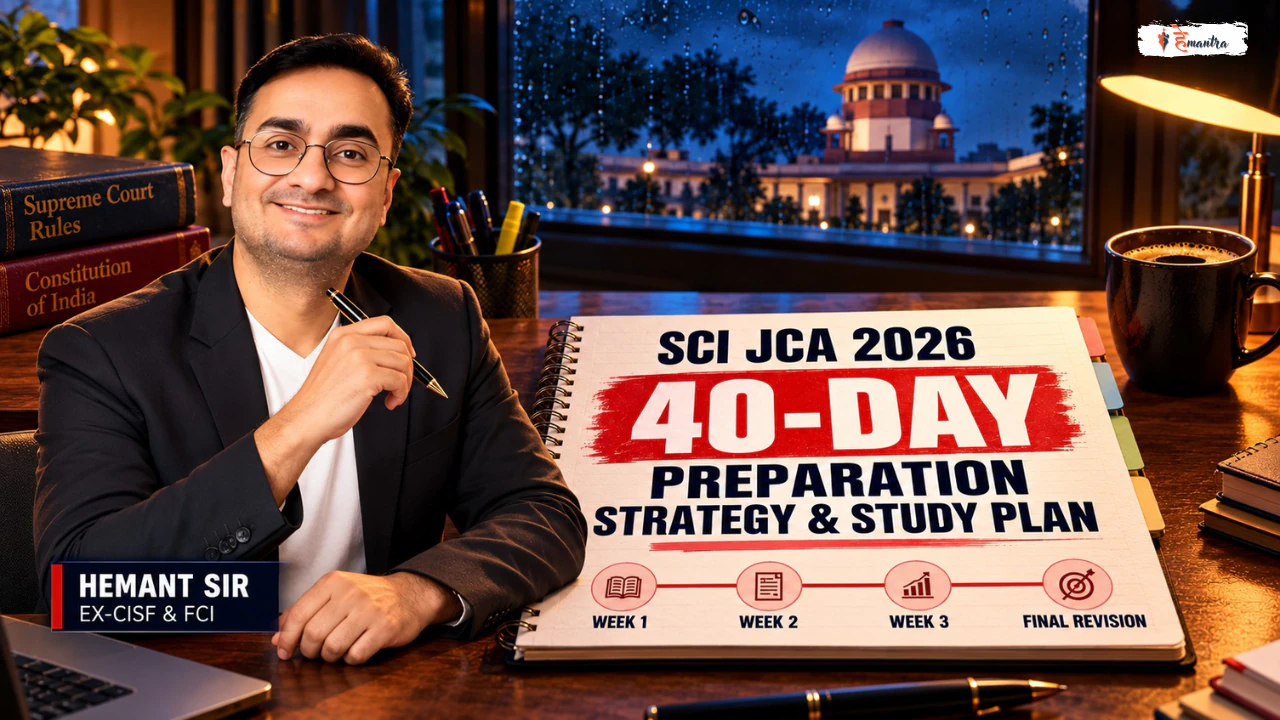
The SCI JCA 2026 preparation strategy must be based on the new exam pattern, not the previous JCA cycle. The Objective Type Test now contains seven areas, and 35 out of 100 questions come directly from Judiciary provisions in the Constitution, Supreme Court Rules, 2013, and Supreme Court Officers & Servants Rules, 1961. Candidates have only 90 minutes, and every incorrect answer attracts a penalty of 0.25 mark. S3WAAS
With about 40 effective study days available, your target should not be to finish the maximum number of books.
Your preparation should follow one cycle:
Learn → Revise → Practise → Test → Analyse → Repeat
That is the foundation of this 40-day plan.
Latest Update / Status
The Supreme Court of India Junior Court Assistant 2026 recruitment is officially underway. The detailed advertisement was issued on 30 September 2026 for 250 tentative vacancies. Online applications opened on 7 October 2026 and will close on 28 October 2026 at 11:55 PM. The Objective Type Test is tentatively scheduled for 20 November 2026. S3WAAS
As of 9 October, there are roughly 42 days before the tentative test date. Therefore, this strategy uses 40 focused study days, leaving approximately two days for light revision, exam logistics and rest.
| Detail | SCI JCA 2026 Status |
|---|---|
| Notification | Released — 30 September 2026 |
| Vacancies | 250 tentative |
| Application Window | 7–28 October 2026 |
| Objective Test | 20 November 2026 — tentative |
| Questions | 100 |
| Duration | 90 minutes |
| Minimum Qualifying Marks | 50 |
| Negative Marking | 0.25 per incorrect answer |
The Supreme Court recruitment page currently lists the detailed advertisement and online application link. Supreme Court of India
Can SCI JCA 2026 Be Prepared in 40 Days?
Yes, 40 days can be a useful preparation window if your resources are controlled and your study plan follows the actual weightage of the paper.
Candidates who already have a foundation in English, aptitude, GK or computer knowledge should devote additional attention to the new Supreme Court-specific sections.
A beginner can also make significant progress in 40 days, but should avoid trying to cover every available source.
The biggest mistake at this stage is:
studying everything once instead of studying important material repeatedly.
Understand the Latest SCI JCA 2026 Exam Pattern First
The official notification gives the following distribution for the Objective Type Test. S3WAAS
| Subject | Questions | Priority |
|---|---|---|
| General English including Comprehension | 20 | High |
| General Aptitude | 15 | High |
| General Knowledge | 15 | Medium-High |
| Judiciary provisions in the Constitution of India | 15 | Very High |
| Supreme Court Rules, 2013 | 10 | Very High |
| Supreme Court Officers & Servants Rules, 1961 | 10 | Very High |
| Computer Knowledge | 15 | High |
| Total | 100 |
The test carries 100 marks, lasts 1½ hours, and requires 50 minimum qualifying marks under the notified scheme. S3WAAS
What changes your preparation most?
The three judiciary/Supreme Court-specific sections together contribute:
35 questions
That is more than one-third of the objective paper.
So a student preparing mainly English, Maths, GK and Computer and leaving Court-specific subjects for the final week would be taking an unnecessary risk.
Subject-Wise Priority for SCI JCA 2026
1. Judiciary Provisions in the Constitution
This section carries 15 questions.
Do not prepare it like unlimited General Polity.
Focus specifically on provisions concerning the Supreme Court, High Courts, subordinate judiciary, jurisdiction, appointments, powers and constitutional remedies.
A useful preparation method is:
Article → Provision → Authority → Power/Function → MCQ → Revision
Avoid memorising Article numbers without understanding what they provide.
For example, if you study an Article relating to the Supreme Court, ask:
Who exercises the power?
What is the provision about?
Is any authority involved?
Is there a condition or exception?
This converts constitutional reading into objective-test preparation.
2. Supreme Court Rules, 2013
The Supreme Court Rules carry 10 dedicated questions. S3WAAS
The Supreme Court’s official Rules page contains the Supreme Court Rules, 2013 together with amendments issued in 2024 and 2025. Students should therefore use the current official material rather than relying entirely on an old PDF. Supreme Court of India
The best exam-oriented method is:
Order → Rule → Main Provision → Authority → Important Number/Time → Exception
While studying, repeatedly ask:
- Who can take the action?
- Who has the authority?
- What procedure applies?
- Is there a time limit?
- Is there an exception?
Reading the Rules once from beginning to end is not enough.
You need short notes + active recall + repeated revision.
3. Supreme Court Officers & Servants Rules, 1961
This section also contributes 10 questions. S3WAAS
The official Supreme Court page currently hosts the Rules as amended up to 6 November 2024, along with the Schedule and the 2025 amendment relating to Rule 4A. Supreme Court of India
Prepare them through:
Rule → Authority → Service condition → Important provision → Exception
These Rules are factual in nature, so repeated recall is more effective than passive reading.
4. General English
English contributes 20 questions, the highest weightage of any single listed section. S3WAAS
Your approach should be:
Grammar concept → Questions → Error analysis → Revision
Give attention to grammar application, vocabulary, sentence usage and comprehension.
Avoid spending the next two weeks merely reading a grammar book.
Every concept should quickly move into question practice.
5. General Aptitude
General Aptitude contributes 15 questions.
For each topic:
Understand the concept → note formula/method → practise questions → attempt timed questions → analyse errors
Your target is not advanced mathematics.
Your target is accurate solving under time pressure.
If a topic is already strong, reduce its study time and use that time for weaker areas.
6. Computer Knowledge
Computer Knowledge contributes 15 questions within the same objective paper. S3WAAS
For factual topics, prepare concise notes and revise them repeatedly.
A useful cycle is:
Concept → Short notes → MCQs → Wrong-answer revision
Do not confuse watching lectures with preparation. You should be able to answer questions without looking at the source.
7. General Knowledge
GK also carries 15 questions, but it can become a resource trap.
Do not try to complete “all GK.”
Use:
Relevant static GK + important current developments + PYQ observations + revision
The closer you get to the examination, the fewer new GK sources you should add.
Where a structured course fits naturally
If you prefer a structured HeMantra learning path instead of collecting separate resources for conventional subjects, you can use Yato Dharma Vijay – यतो धर्मस्ततो जयः SCI JCA Complete Course 2026 alongside this plan. Use the official 2026 notification as the final reference for section-wise priority while following the course for organised preparation and practice.
SCI JCA 2026: Practical 40-Day Study Plan
Do not create 40 disconnected daily targets.
Divide the preparation into five phases.
Phase 1 — Days 1–10: Build the Foundation
The priority of the first ten days should be the new Supreme Court-specific areas.
Focus daily on:
Judiciary provisions
Supreme Court Rules
Officers & Servants Rules
Keep at least one conventional subject active every day.
A six-hour plan can look like this:
| Task | Approx. Time |
|---|---|
| Judiciary / Constitution | 1.5 hours |
| Supreme Court Rules / Officers Rules | 1.5 hours |
| English / Aptitude | 1.25 hours |
| GK / Computer | 45 minutes |
| Practice / Revision | 30 minutes |
| Typing | 30 minutes |
By Day 10, your objective should be first-level familiarity, not perfection.
Phase 2 — Days 11–20: Complete Core Coverage
Now increase conventional-subject practice without abandoning the Rules.
Start sectional tests.
The key question should change from:
“Have I read this topic?”
to:
“Can I answer a question from it without opening my notes?”
During this phase:
- revise Court-specific subjects every 2–3 days;
- identify weak grammar areas;
- record repeated aptitude mistakes;
- revise Computer facts;
- maintain controlled GK notes;
- continue daily typing.
By Day 20, every official section should have been covered at least once.
Phase 3 — Days 21–30: PYQs + Mixed Practice
The third phase should reduce passive learning.
Use PYQs to understand:
Difficulty level → recurring concepts → time requirement → weak topics → question selection
For previous-paper practice, HeMantra’s SCI PYQs Master Course provides paper-wise and topic-wise previous questions with explanations.
But remember: older PYQs cannot fully represent the newly introduced dedicated judiciary and Rules weightage.
Use PYQs for the established subjects and supplement them with current-pattern practice for the new sections.
During Days 21–30:
- attempt mixed tests;
- revise Rules a second time;
- build a mock-error notebook;
- practise solving under time pressure;
- stop spending equal time on already strong topics.
Phase 4 — Days 31–36: Full-Length Mock Phase
Now prepare for the actual test condition:
100 Questions in 90 Minutes
Do not judge a mock only by the final score.
After every test, track:
| Metric | What It Tells You |
|---|---|
| Attempted | Are you attempting too much or too little? |
| Correct | Productive attempts |
| Incorrect | Negative-marking loss |
| Accuracy | Reliability |
| Time | Slow sections |
| Guessing errors | Avoidable losses |
| Weak topics | Immediate revision target |
The official notification prescribes 0.25 negative marking for each incorrect answer. S3WAAS
Therefore:
Attempt strategy matters almost as much as knowledge.
If five extra guesses produce four wrong answers, those attempts may reduce rather than improve your score.
A mock is useful only when its mistakes change your next study session.
Phase 5 — Days 37–40: Final Revision
The last four core study days should be used for recall.
Revise:
- Supreme Court Rules short notes
- Officers & Servants Rules
- Judiciary Articles
- Computer facts
- Aptitude formulas
- English weak areas
- GK revision sheets
- PYQ mistakes
- Mock-test error notebook
Do not open a new 400-page source because someone shares it a few days before the examination.
The final four days are for recall, not resource discovery.
The remaining two buffer days before the tentative 20 November exam can be used for light revision, exam-centre planning, document/admit-card checks and proper sleep.
Daily Typing Practice: Start Now
The recruitment process does not end with the Objective Test.
The official scheme includes an English Typing Speed Test on Computer requiring a minimum speed of 35 WPM.
The test lasts 10 minutes, carries 50 marks, has 25 minimum qualifying marks, and permits mistakes up to 3% of the total words typed. S3WAAS
Do not wait for the Objective Test result before starting typing.
Days 1–10
Prioritise accuracy.
Days 11–25
Increase speed gradually.
Days 26–40
Practise regular 10-minute timed passages.
Track four things:
Gross WPM | Net WPM | Accuracy | Mistakes
Try to develop some margin above the official 35 WPM requirement.
Typing is a skill.
Watching typing videos cannot replace typing.
How to Use PYQs Correctly
Many students solve a previous paper, check the score and move on.
That misses the main value of PYQs.
Classify every wrong answer into one of these categories:
Concept error — you did not understand the topic.
Memory error — you studied it but forgot.
Calculation error — your concept was correct but execution failed.
Reading error — you misunderstood the question.
Guessing error — unnecessary risk.
Time-pressure error — you knew it but could not solve efficiently.
Each type requires a different correction.
That is why:
PYQ analysis is more important than simply counting how many PYQs you solved.
Common Mistakes to Avoid in the Next 40 Days
The biggest preparation errors are often strategic rather than academic:
- Preparing according to the older JCA pattern.
- Ignoring the 35-question Judiciary + Rules block.
- Using too many books, PDFs and Telegram files.
- Reading Supreme Court Rules passively without active recall.
- Waiting for syllabus completion before attempting tests.
- Giving equal time to every subject regardless of weakness and weightage.
- Ignoring typing until after the objective result.
- Taking mocks without analysing mistakes.
- Over-attempting despite negative marking.
- Starting new sources in the final week.
Your resource list should become smaller as the examination approaches.
Your revision frequency should become higher.
Final Guidance from Hemant Sir
Do not think of SCI JCA 2026 as seven unrelated subjects.
Divide the preparation into three blocks:
Block 1 — Supreme Court-Specific
Judiciary + Supreme Court Rules + Officers & Servants Rules
Block 2 — Core Scoring
English + Aptitude + Computer + GK
Block 3 — Exam Skills
PYQs + Mocks + Time Management + Typing
Then repeat the same cycle:
Learn → Revise → Test → Analyse → Repeat
In a 40-day window, the candidate who repeatedly revises a limited set of relevant resources can be better prepared than the candidate who keeps discovering new material until the last week.
The objective is not:
“How much did I study?”
The better question is:
“How much can I accurately recall and apply under 90-minute exam pressure?”
SCI JCA 2026 FAQs
Can I prepare for SCI JCA 2026 in 40 days?
Yes, 40 focused days can provide a strong preparation cycle, particularly if you already have basic knowledge of English, aptitude, GK or computer subjects. No timetable can guarantee selection; execution, revision and test performance remain decisive.
Which subject should I start first?
Start the Judiciary and Supreme Court-specific subjects early, because together they account for 35 questions. Continue English, Aptitude, Computer and GK in parallel. S3WAAS
How many hours should I study daily?
There is no fixed number. A focused 5–6 hour schedule can accommodate this plan, but candidates with 3–4 hours should preserve the same priority order and reduce duration rather than skipping important sections.
Are SCI JCA PYQs enough?
No. They are essential for understanding past question level and recurring concepts, but the 2026 objective pattern contains dedicated judiciary and Rules sections that require additional current-pattern preparation.
When should I start mock tests?
Start topic and sectional tests early. Shift to mixed tests during the middle phase and full-length 100-question, 90-minute mocks during approximately the final 10 days.
Should I start typing before the Objective Test?
Yes. The official Typing Test requires 35 WPM with the specified error limit, and typing speed develops through consistent practice rather than last-minute preparation. S3WAAS
What should I study in the final four days?
Revise Rules, judiciary provisions, computer facts, formulas, English weak areas, GK notes and your PYQ/mock-error notebook. Avoid large new resources.
Conclusion
The SCI JCA 2026 preparation strategy should begin with the changed official pattern.
You have:
35 questions from Judiciary and Supreme Court-specific Rules,
20 questions from English,
15 each from Aptitude, GK and Computer. S3WAAS
So do not divide 40 days equally among every source and every topic.
Prioritise the Court-specific block, keep the scoring subjects active, practise typing from the beginning, use PYQs to understand the paper and spend the final phase on mocks, error correction and revision.
The purpose of a 40-day plan is not to make you study more material.
It is to make your preparation more selective, more test-oriented and more reliable.

[…] SCI JCA 2026: 40-Day Preparation Strategy & Study Plan […]
[…] a complete study-and-testing timeline, HeMantra’s SCI JCA 2026: 40-Day Preparation Strategy & Study Plan explains how to move from syllabus coverage to PYQs, sectional testing, full mocks and final […]