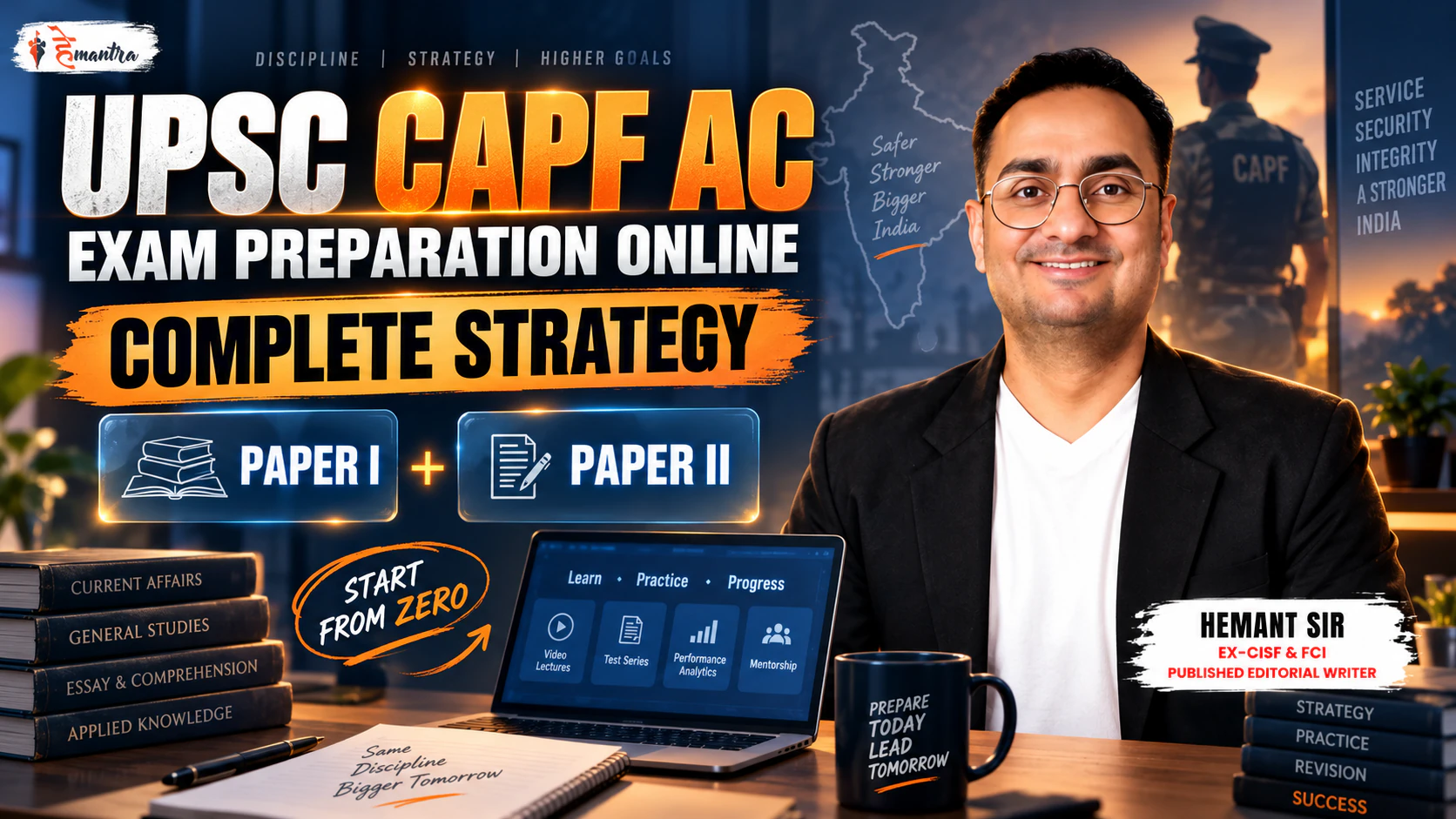
Preparing for the UPSC CAPF Assistant Commandant examination online is completely possible today. The real difficulty is no longer access to study material.
The real difficulty is too much material.
An aspirant may have YouTube lectures, PDFs, Telegram channels, current-affairs magazines, mock tests and multiple courses—and still remain confused about what to study next.
That is why successful UPSC CAPF AC exam preparation online needs a system.
The objective should not be to consume maximum content. It should be to convert your preparation into:
Knowledge → Practice → Testing → Writing → Evaluation → Improvement
This guide explains how to prepare for CAPF online for both Paper I and Paper II without falling into the trap of information overload.
First Understand What CAPF Actually Demands
CAPF preparation requires two very different abilities.
Paper I — General Ability and Intelligence
Paper I tests areas such as:
- General Mental Ability
- General Science
- Current Affairs
- Indian Polity and Economy
- History
- Indian and World Geography
This paper requires:
Concepts + Revision + MCQs + PYQs + Test Practice
Paper II — General Studies, Essay and Comprehension
Paper II tests:
- Essay writing
- Analytical ability
- Comprehension
- Précis writing
- Counter-arguments
- Grammar and language skills
This paper requires:
Content + Expression + Structure + Writing Practice + Evaluation
This difference is important.
You cannot prepare Paper II simply by applying the same method you use for Paper I.
1. Start Online CAPF Preparation With the Syllabus
The biggest mistake online aspirants make is starting with resources instead of the syllabus.
They search:
- Best Polity teacher
- Best current affairs channel
- Best CAPF book
- Best test series
before clearly understanding what UPSC expects.
The correct order is:
Syllabus → PYQs → Resources
Before studying any topic, ask:
Which part of the CAPF syllabus am I covering?
For the latest official syllabus, exam notifications and other updates, candidates should refer to the Official UPSC Website.
This one habit can dramatically reduce unnecessary study.
If you are a beginner, first read our UPSC CAPF AC 2027 Syllabus & Exam Pattern guide and understand both papers before making your study plan.
2. Use CAPF PYQs as Your Filter
Previous Year Questions should not be something you solve only after completing the syllabus.
They should guide your preparation from the beginning.
CAPF PYQs tell you:
- What UPSC actually asks
- Which topics are repeatedly important
- How questions are framed
- How deep you need to study
- Which facts matter
- How current affairs connects with static subjects
A better approach is:
- Before starting Polity → check Polity PYQs
- Before starting Geography → check Geography PYQs
- Before starting Paper II → analyse descriptive PYQs
HeMantra provides free year-wise CAPF PYQs from 2020–2026, which can be used to understand the recent examination pattern.
But don’t simply check the answer.
Ask:
- Why was this question asked?
- Why are the other options wrong?
- Which syllabus area does it belong to
- What similar question could UPSC ask next?
That is real PYQ analysis.
3. Prepare Paper I Through Learn → Practise → Test
Watching a lecture does not mean a subject has been prepared.
Paper I preparation should move through stages:
Concept
Understand the topic.
↓
Topic-wise Questions
Check whether you can apply the concept.
↓
PYQs
Understand UPSC’s standard.
↓
Sectional Test
Test one subject under pressure.
↓
Multi-Sectional Test
Combine subjects.
↓
Full-Length Mock
Simulate the examination.
This progressive approach is much better than starting with random full-length mocks.
HeMantra’s ABHYAS MANTHAN 2027 follows this structured testing approach through sectional tests, multi-sectional tests, full-length mocks and performance analysis.
4. Analyse Your Mock — Don't Just Check Marks
Many students attempt an online mock and immediately ask:
“Kitne marks aaye?”
That is only the first question.
The more useful questions are:
- How many questions did I attempt?
- What was my accuracy?
- How much did negative marking cost me?
- Which subject pulled my score down?
- Did I guess too much?
- Which easy questions did I leave?
- Was the mistake conceptual or factual?
- Did I manage time properly?
Suppose two students score 110.
One has poor accuracy because of over-attempting.
The other has good accuracy but attempts too few questions.
Their scores are the same.
Their problems are completely different.
A mock without analysis is only half a mock.
5. Start Paper II Alongside Paper I
This is one of the most important rules of CAPF preparation.
Do not say:
“Paper I complete hone ke baad Paper II karunga.”
Paper I is largely knowledge-oriented.
Paper II is largely skill-oriented.
Skills take time.
You cannot suddenly improve:
- Essay structure
- English expression
- Précis writing
- Comprehension
- Analytical thinking
- Argument development
in the final few weeks.
Even if Paper I is your priority initially, start Paper II with 2–3 writing sessions every week.
6. Identify Your Real Paper II Weakness
Students often say:
“My Paper II is weak.”
But that is too broad.
Your actual weakness may be:
Content Weakness
You don’t know enough points to write.
Expression Weakness
You know the point but cannot frame it properly.
Structure Weakness
Your essay has content but lacks flow.
English Weakness
You think in Hindi and translate every sentence.
Practice Weakness
You read model answers but rarely write.
Evaluation Weakness
You write, but nobody tells you what is wrong.
The solution depends on the problem.
That is why Paper II preparation should be personalised rather than simply collecting model essays.
7. Online Paper II Preparation Must Include Evaluation
Reading an excellent essay is useful.
But it does not prove that you can write one.
A student may write ten essays with:
- weak introductions
- repetitive arguments
- poor examples
- grammatical errors
- abrupt conclusions
and repeat the same mistakes every time.
The better process is:
Write → Evaluate → Identify → Correct → Rewrite → Improve
This is the philosophy behind ABHYAS LEKHAN 2027, where HeMantra focuses on descriptive writing, assignments, PYQs and personalised evaluation.
Evaluation should not merely say:
“Good answer — 6/10.”
It should help you understand:
What exactly should change in the next answer?
8. Improve English Through Writing, Not Vocabulary Lists
Many CAPF aspirants already know what they want to say.
Their problem is expression.
They often follow:
Think in Hindi → Translate → Write in English
This can create unnatural sentences.
For example:
Weak:
AI is increasing day by day and because of it many jobs can go.
Better:
Artificial intelligence can improve productivity, but rapid automation may also displace certain categories of employment.
The second sentence is not difficult English.
It is simply clearer.
Your target should be:
Simple + Correct + Clear + Analytical English
You do not need unnecessarily difficult vocabulary to score well.
9. Use Current Affairs for Both Papers
Online students often waste a lot of time following too many current-affairs sources.
The solution is not to read more.
It is to use current affairs better.
Take Artificial Intelligence.
For Paper I, you may study:
- technology
- applications
- institutions
- recent developments
For Paper II, the same topic can help with:
- employment
- national security
- education
- privacy
- governance
This is how one topic serves both papers.
HeMantra’s Daily Dispatch is designed around this approach—current affairs should not simply be read; they should become usable examination content.
10. Control Your Online Resources
Online preparation becomes difficult when every day brings a new teacher, new PDF and new strategy.
For most aspirants, a limited system is enough:
- One syllabus
- One main source per subject
- One PYQ source
- One current-affairs system
- One test platform
- One Paper II evaluation system
Your goal is not to collect the best resource available on the internet for every topic.
Your goal is to revise the resources you already selected.
Revision beats resource accumulation.
11. Follow a Realistic Daily Online Study Plan
A CAPF beginner can structure the day approximately like this:
| Area | Suggested Time |
|---|---|
| Static Paper I Subject | 2–3 hours |
| Current Affairs | 45 minutes |
| MCQs/PYQs | 1 hour |
| Revision | 45 minutes |
| Paper II | 45–60 minutes |
This is only a framework.
A working aspirant or college student may have less time.
The important principle is:
Paper I + Current Affairs + Questions + Revision + Paper II
should all appear regularly in your schedule.
12. Avoid Passive Online Preparation
Online learning has one major danger.
You can watch ten lectures and feel highly productive.
But UPSC will never ask:
“How many lectures did you complete?”
It will ask you to:
- Recall.
- Solve.
- Analyse.
- Write
Therefore, measure your preparation through:
- PYQs completed
- MCQs solved
- Accuracy improved
- Essays written
- Mistakes corrected
- Mocks attempted
- Revision cycles completed
not merely:
Hours of video watched.
13. When Should You Consider Online Coaching?
Online coaching can be useful when you need:
- Structured direction
- Regular testing
- Paper II evaluation
- Mentorship
- Accountability
- Performance analysis
But you should not join a course simply because it contains 500+ lectures.
Before choosing online CAPF coaching, ask:
- Does it cover both papers?
- Does it use PYQs?
- Does it provide sectional and full-length tests?
- Is Paper II actually evaluated?
- Does it provide feedback?
- Does it help identify weaknesses?
- Does it reduce confusion or create more material?
The right coaching should make your preparation simpler and more measurable.
HeMantra's Online CAPF Preparation Ecosystem
For students who need structured support, HeMantra currently provides different pathways.
ABHYAS MANTHAN 2027
Focused on Paper I testing, including sectional, multi-sectional and full-length tests, detailed solutions and performance analysis.
It also includes the 10-Day Challenge, designed to build exam temperament, speed, accuracy and consistency.
ABHYAS LEKHAN 2027
Focused on Paper II, including:
- Essay writing
- Précis
- Comprehension
- Argument writing
- Language improvement
- Assignments
- PYQ discussion
- Personalised evaluation
ABHYAS ULTIMATE 2027
For aspirants seeking a more integrated Paper I + Paper II preparation system.
But a beginner does not necessarily need to purchase a course immediately.
Start with HeMantra’s free PYQs, Daily Dispatch and study resources, identify your actual weakness and then choose structured guidance if required.
Can You Clear CAPF Through Online Preparation?
Yes.
Online preparation can provide access to:
- Classes
- PYQs
- Current affairs
- Test series
- Writing practice
- Evaluation
- Mentorship
without requiring you to relocate.
But online preparation demands something from the student:
Self-discipline
- No online course can revise for you.
- No mentor can write your Paper II.
- No test series can improve your score if you never analyse the test.
- The platform can provide the system
You have to execute it.
Final Takeaway
Successful UPSC CAPF AC exam preparation online is not about having the maximum number of resources.
It is about building a preparation system that converts effort into performance.
For Paper I:
Learn → Practise → Test → Analyse
For Paper II:
Write → Evaluate → Correct → Improve
For Current Affairs:
Understand → Organise → Revise → Apply
And for online preparation as a whole:
Consume Less. Practise More.
Whether you prepare from Delhi or from a small town does not decide your result.
What matters is whether, on examination day, you can:
- Recall accurately.
- Solve intelligently.
- Write clearly.
- And perform under pressure.
HeMantra — Building the Foundation.
Frequently Asked Questions
Can I prepare for UPSC CAPF completely online?
Yes. CAPF syllabus preparation, PYQs, mock tests, current affairs, Paper II writing and evaluation can all be done online. However, regular self-study and revision remain essential.
When should I start CAPF Paper II?
Ideally, alongside Paper I. Writing skills develop gradually and should not be postponed until the final phase of preparation.
What should a CAPF beginner study first?
Begin with the syllabus, analyse PYQs, choose limited subject resources and start regular Paper I practice and basic Paper II writing.
How many hours should I study for CAPF?
There is no fixed number. The quality and consistency of study matter more than simply counting hours. A realistic plan that you can follow for months is better than an unsustainable 10-hour schedule.
Are mock tests necessary for CAPF?
Yes. They help develop speed, accuracy, question selection and exam temperament. But analysing your mistakes after the mock is equally important.
Which HeMantra programme focuses on Paper I?
ABHYAS MANTHAN 2027 focuses primarily on structured Paper I testing and performance analysis.
Which HeMantra programme focuses on Paper II?
ABHYAS LEKHAN 2027 focuses on descriptive-writing preparation, practice and personalised evaluation.