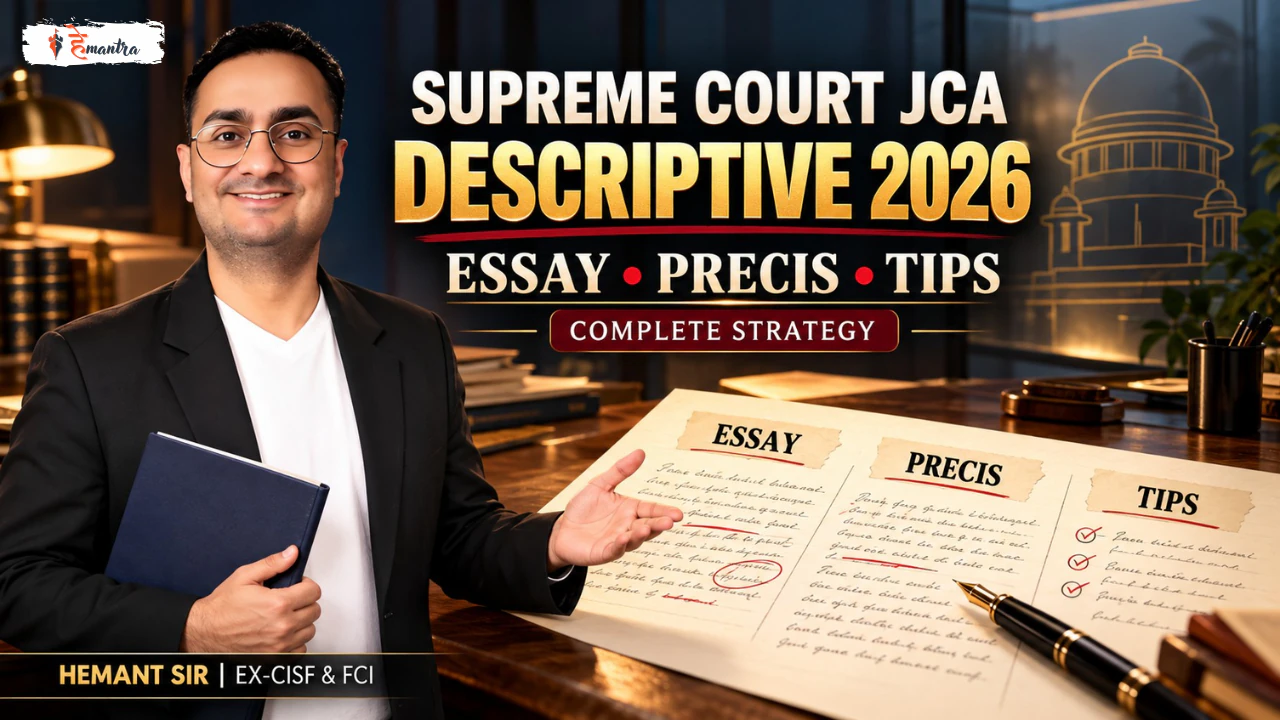
The Supreme Court JCA Descriptive Preparation 2026 requires a different approach from the Objective Test. This stage is not about selecting the correct option; it tests whether you can understand a passage, identify the central idea, organise your thoughts and express them clearly in English.
According to the official 2026 recruitment scheme, the Written Descriptive Test consists of:
Comprehension Passage + Precis Writing + Essay Writing
The test carries 100 marks, has a duration of 2 hours, and candidates need at least 50 marks to qualify.
Another important rule is that the Descriptive answer sheet will be evaluated only for candidates who successfully qualify the Typing Speed Test.
So your preparation should follow one clear cycle:
Learn → Write → Evaluate → Correct → Rewrite
For the complete exam structure, candidates should first understand the overall recruitment process through Supreme Court JCA Recruitment 2026 – Complete Guide.
Latest Update
The official SCI JCA 2026 advertisement confirms that the Written Descriptive Test is conducted in English for 100 marks over 2 hours, with 50 minimum qualifying marks. The notified components are Comprehension, Precis Writing and Essay Writing.
The Typing Speed Test and Written Descriptive Test will be conducted in Delhi/NCR, and their dates will be notified separately on the Supreme Court website.
Candidates should therefore rely only on the official recruitment portal for the Descriptive Test schedule.
Supreme Court JCA Descriptive Test 2026: Key Highlights
| Particular | Official Details |
|---|---|
| Test | Written Test – Descriptive |
| Language | English |
| Maximum Marks | 100 |
| Duration | 2 Hours |
| Minimum Qualifying Marks | 50 |
| Components | Comprehension + Precis + Essay |
| Venue | Delhi/NCR |
| Section-wise Marks | Not separately specified |
| Evaluation Condition | Typing Test must be qualified |
The official advertisement specifies the total marks and the three components, but it does not provide a separate marks distribution for Essay, Precis and Comprehension.
Therefore, candidates should prepare all three sections seriously instead of assuming an unofficial marks breakup.
How Should You Prepare for SCI JCA Descriptive 2026?
The biggest mistake is to prepare descriptive writing through reading alone.
Reading good answers can improve awareness, but it does not automatically improve:
writing speed,
structure,
grammar,
argument development,
precis technique, or
answer presentation.
Your preparation should follow:
Concept → Practice → Evaluation → Correction
Essay, Precis and Comprehension require different techniques, so all three should be practised simultaneously.
Candidates preparing for Stage-I alongside descriptive writing can follow the SCI JCA 2026 40-Day Preparation Strategy & Study Plan.
Essay Writing Strategy for Supreme Court JCA
A good SCI JCA essay should be clear, relevant and logically organised.
You do not need unnecessarily difficult vocabulary.
Use a simple three-part structure.
Introduction
Introduce the topic directly.
Avoid generic lines that could fit almost any essay.
The introduction should establish:
What is the issue? Why does it matter?
Main Body
Break the topic into logical dimensions.
Depending on the subject, you can use frameworks such as:
Causes → Consequences → Challenges → Solutions
or
Social → Economic → Administrative → Technological
Use relevant examples, government initiatives, recent developments or institutional perspectives where they strengthen the argument.
But remember:
Facts should support your argument, not replace it.
Conclusion
The conclusion should bring the discussion together.
Avoid merely repeating your introduction.
A balanced, practical and forward-looking ending usually works better.
How to Improve Precis Writing
Precis Writing is one of the most technique-based sections of a descriptive examination.
A precis is not simply a shorter passage.
It should preserve:
Central Idea + Logical Flow + Essential Arguments
while removing:
examples,
repetition,
unnecessary descriptions,
decorative language, and
secondary details.
Use this process:
Step 1 — Read the Entire Passage
Understand the passage before shortening it.
Step 2 — Identify the Central Idea
Ask:
What is the author fundamentally trying to communicate?
Step 3 — Mark Essential Points
Separate the main argument from illustrations and examples.
Step 4 — Rewrite in Your Own Words
Do not simply lift sentences and connect them.
Step 5 — Review
Check whether your precis remains coherent and retains the original meaning.
Remember:
A good precis is compressed, not incomplete.
How to Score Better in Comprehension
Comprehension primarily tests understanding and precision.
Do not add unnecessary outside knowledge.
A useful method is:
Read Question → Locate Passage → Understand → Answer Directly
Your answer should be:
relevant,
concise,
grammatically correct,
based on the passage.
Practise questions based on:
central idea,
inference,
author’s viewpoint,
vocabulary in context,
factual information,
analytical interpretation.
One common mistake is copying an entire paragraph when only two or three sentences are required.
The objective is not to write the longest answer.
Answer exactly what has been asked.
A Practical Weekly Writing Strategy
You do not need to attempt a complete two-hour descriptive paper every day.
A structured weekly routine can be more sustainable.
| Day | Practice |
|---|---|
| Monday | Essay Writing |
| Tuesday | Precis Writing |
| Wednesday | Comprehension |
| Thursday | Essay Writing |
| Friday | Precis + Comprehension |
| Saturday | Mixed Timed Practice |
| Sunday | Full Mock + Evaluation |
The Sunday session is particularly important.
A mock tells you how you performed.
Evaluation tells you why you performed that way.
Why Answer Evaluation Matters
Many candidates write repeatedly but continue making the same mistakes.
Common problems include:
weak introduction,
repetitive arguments,
poor paragraph flow,
grammar errors,
irrelevant points,
unclear sentences,
weak conclusion,
poor time management.
After every evaluated answer, create a small error sheet.
| Area | Question to Ask |
|---|---|
| Content | Was my answer relevant? |
| Structure | Was the argument logically organised? |
| Grammar | Which errors repeated? |
| Expression | Were my sentences clear? |
| Presentation | Was the answer easy to read? |
| Time | Did I finish within the limit? |
Before attempting the next answer, review your previous feedback.
That turns evaluation into actual improvement.
SCI JCA Descriptive 2026 Course with Answer Evaluation
Candidates who want structured preparation can use the SCI JCA Descriptive 2026 – Complete Preparation Course.
SCI JCA Descriptive 2026 – Complete Preparation Course
The course includes:
Essay Writing,
Precis Writing,
Comprehension Passage,
exam-oriented writing techniques,
time-management strategy,
practice exercises,
mock tests,
doubt-clearing sessions, and
Descriptive Answer Evaluation & Feedback.
The evaluation covers content relevance, grammar, spelling, sentence structure, organisation, clarity and presentation.
The purpose of evaluation is not simply to receive marks.
Ask after every evaluated answer:
What exactly should I change in my next attempt?
Watch SCI JCA Descriptive Classes on HeMantra YouTube
Video sessions can help you understand essay structure, precis technique, comprehension approach and descriptive-writing strategy before you begin practice.
Follow the official HeMantra channel:
HeMantra Official YouTube – SCI JCA Descriptive Classes
For descriptive preparation, look specifically for sessions related to:
SCI JCA Descriptive 2026
Essay Writing
Precis Writing
Reading Comprehension
Descriptive Strategy
Time Management
Answer Writing
Use videos with this cycle:
Watch → Attempt Yourself → Evaluate → Rewrite
Do not watch multiple strategy videos without attempting actual answers.
Writing improves through writing.
How to Manage the 2-Hour Descriptive Test
The official test duration is 2 hours, but no separate time limit is prescribed for Essay, Precis and Comprehension.
Your section-wise timing should therefore be developed through mock tests.
A useful practice framework is:
First 5–10 Minutes: Read the complete paper and decide your sequence.
Main Writing Period: Attempt all three sections with disciplined timing.
Final 10 Minutes: Review grammar, spelling, incomplete sentences and presentation.
Do not spend excessive time perfecting one answer while leaving another section incomplete.
Completing all sections with good quality is better than writing one perfect answer and rushing the rest.
Prepare Typing and Descriptive Together
One of the most important SCI JCA rules is that your Descriptive answer sheet will be evaluated only after you qualify the Typing Speed Test.
Therefore, do not prepare the two stages separately.
Read the complete typing requirements here:
Supreme Court JCA Typing Test 2026: Speed, Duration & Rules
A practical daily combination can be:
30 Minutes Typing + 30–45 Minutes Descriptive Writing
Typing improves through repetition.
Descriptive writing improves through:
Practice + Evaluation + Correction
Both need time to develop.
Common Mistakes in SCI JCA Descriptive Preparation
Reading More but Writing Less
Knowledge alone cannot improve writing speed or structure.
Memorising Complete Essays
The exact essay topic may never appear. Learn arguments and frameworks instead.
Using Difficult Vocabulary
Simple and correct English is better than complicated language used incorrectly.
Ignoring Precis Technique
Precis Writing has its own rules and should not be treated as ordinary summarisation.
Copying Comprehension Passages
Use information from the passage, but write direct answers.
Practising Without Time Limits
Untimed writing may create unrealistic confidence.
Ignoring Evaluation
Writing ten answers with the same mistake is not effective practice.
SCI JCA Descriptive Preparation 2026: Quick Revision
Maximum Marks: 100
Duration: 2 Hours
Qualifying Marks: 50
Language: English
Sections: Comprehension + Precis + Essay
Venue: Delhi/NCR
Section-wise Marks: Not officially specified
Best Preparation Cycle: Write → Evaluate → Correct → Rewrite
Frequently Asked Questions
What is the SCI JCA Descriptive Test pattern 2026?
The Written Descriptive Test is in English, carries 100 marks, lasts 2 hours, and contains Comprehension, Precis Writing and Essay Writing.
What are the qualifying marks?
Candidates need at least 50 marks out of 100.
What should I prepare for SCI JCA Descriptive?
Prepare Essay Writing, Precis Writing and Comprehension along with grammar, structure, time management and answer presentation.
Is the section-wise marks distribution announced?
No. The detailed 2026 advertisement does not separately specify marks for Essay, Precis and Comprehension.
How can I improve descriptive writing?
Use a consistent cycle:
Write → Evaluate → Identify Errors → Correct → Rewrite
Should I start descriptive preparation before the Objective result?
Yes. Essay, Precis and Comprehension are skills that require repeated practice.
Has the SCI JCA Descriptive Test date been announced?
The date is to be notified separately through the Supreme Court website. Candidates should monitor the official recruitment portal.
Conclusion
The Supreme Court JCA Descriptive Preparation 2026 should not be treated as a last-minute stage.
Essay, Precis and Comprehension improve only when candidates write regularly, analyse their weaknesses and correct those weaknesses in the next attempt.
Do not measure your preparation only by the number of essays or precis passages completed.
Measure whether your:
Structure + Relevance + Grammar + Clarity + Time Management
are improving.
The most effective preparation cycle remains:
Write → Evaluate → Correct → Rewrite
Follow it consistently, and descriptive writing becomes a skill you can control rather than an unpredictable examination stage.